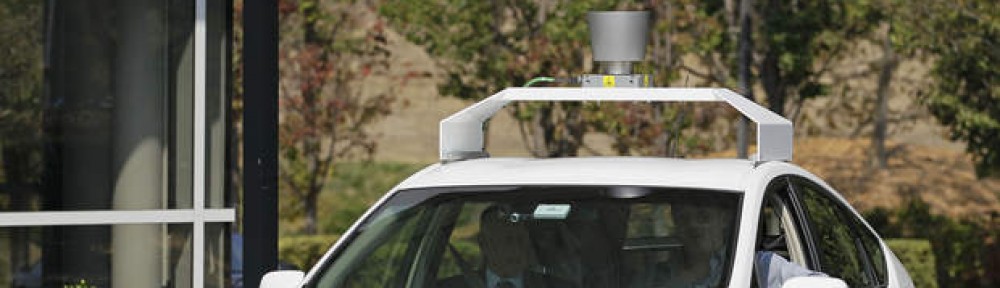
In addition to riding in the Induct automated car at CES this year, I also got to see a number of other technologies related to driverless transportation that are, or will be in new car showrooms soon.
Three of these were related to parking. There were systems on display from Audi, Valeo and Bosch. In addition, I got to test out an emergency braking system from Bosch.
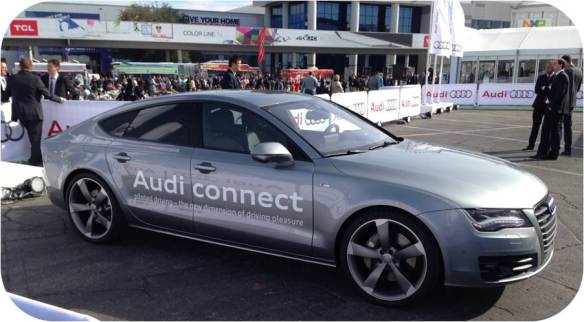
Audi showed two things in their demonstration. The first was having the car park itself in a perpendicular spot. The driver “pulled into the lot” (it was really in a relatively small piece of a lot), got out of the car and, using his cell phone, told the car to go park itself.
During the process, the “driver” is required to hold down a button on his or her phone. If you let up on the button then the car will stop. While this is an interesting safety feature, it does mean that you can’t just get out of the car and let it completely park itself.
Audi’s second demonstration showed the car pulling into and out of a garage by itself. In this case, the driver got in and out of the car outside the garage. That didn’t seem like a typical process in real-life but perhaps it was just for the demo.
The other thing that Audi showed was how little space was required for the electronics: the entire package is controlled from a device in the trunk that was only about the size of an iPad. Previous versions filled up most of the trunk with electronics so this was a big improvement.
The system is not yet available to consumers and they were very non-committal about when it might be.
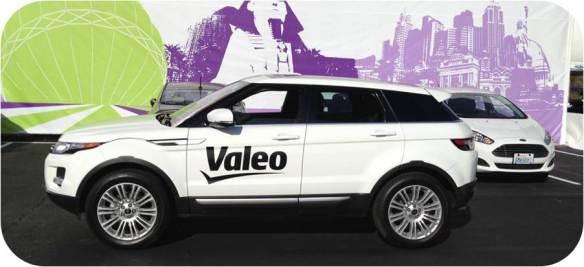
The next demonstration that I saw was from a Tier 1 supplier, Valeo. Similar to Audi’s demonstration, Valeo showed the car finding a spot in a row of cars and then parking by itself, and similar to Audi, it was all controlled from a smart-phone.
Unlike Audi, however, the operator didn’t have to hold a button during the entire process, so he could have walked away. He did have a button on his cell phone to stop the car. I had an interesting discussion with one of Valeo engineers on how this becomes even more capable. I also asked how it would handle parking in a multi-story parking garage. He said that in order for the car to work there, it would need to have been given an electronic map of the garage. (This could happen through a wireless connection as the car approaches the garage).
He thought you’d find this system in production in a couple of years. We’ll see. It seems like it still has a few very significant issues that will need to be overcome.
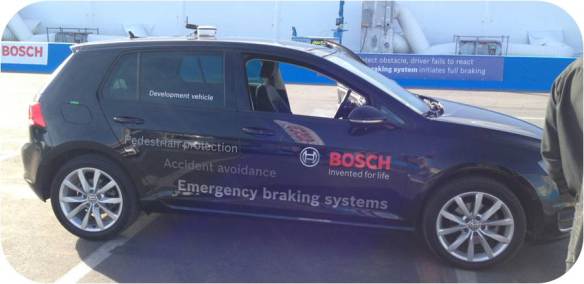
Tier 1 supplier Bosch performed a third set of demonstrations. The first thing they demonstrated was automatic parallel parking, which is a technology that is available today.
I was especially interested in Bosch’s Emergency Braking System, of which I got a firsthand demonstration. They had setup a test track that had a parked car at the end. As we approached the parked car, “Timmy”, a replica little boy, popped out into our path. The system detected Timmy and slammed on the brakes. It was very abrupt but Timmy came out fine. Without this system, we very easily could have hit poor Timmy.
Two small cameras mounted on the windshield side of the rear view mirror controlled the system. I didn’t notice them until the Bosch driver pointed it out.
All in all, it was great to experience these technologies first hand. The first wave of electronic safety and automation in cars is definitely upon us.
John

Reblogged this on Lamia Contract Hire and Leasing.
Pretty nice post. I just stumbled upon your blog and wanted to say that I have really enjoyed browsing your blog posts. After all I’ll be subscribing to your rss feed and I hope you write again soon!