Briefing · Technology
How Automation Is Cutting Processing Times in Transport
Most of the time lost in transport is spent standing still. Automation's clearest gains so far come from removing those waits, not from moving faster.
Briefing
Most of the time lost in transport is not spent moving. A container waits on a quay for a crane, a truck idles in a gate queue while its paperwork is checked, a driver parks for a mandated rest break, a passenger stands at the kerb while a car is dispatched. Automation's most measurable effect so far has been on that stationary time rather than on top speed, and it is a more useful lens on the industry than the perennial question of when a car will drive itself everywhere.
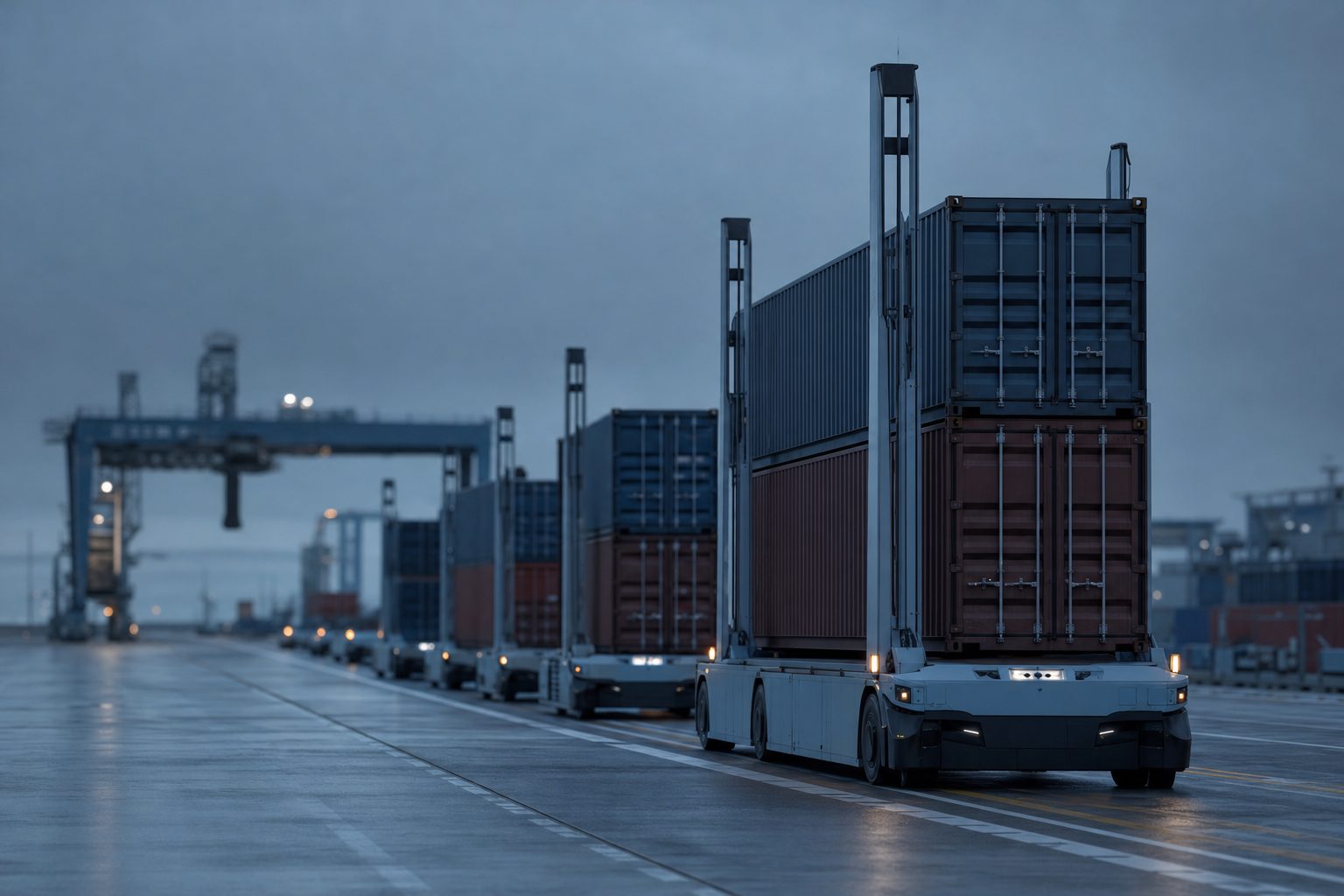
Container terminals were the first place this showed up at scale. Automated terminals such as the two that opened on Rotterdam's Maasvlakte II in 2015 run driverless vehicles and remotely supervised stacking cranes between the quay and the yard, with gate systems that read container numbers and licence plates by camera instead of by clerk. The vehicles are not faster than a human-driven straddle carrier. The gain comes from scheduling: a terminal operating system that knows where every box sits, and which truck is coming for it, can stage the container before the truck reaches the gate, and that is where the minutes in a truck turn time are actually recovered.
Long-haul trucking has a different constraint, and it is written into law. In the United States, the Federal Motor Carrier Safety Administration's hours-of-service rules cap a property-carrying driver at 11 hours of driving inside a 14-hour on-duty window, followed by 10 consecutive hours off. A driverless truck is not bound by that clock, which is why hub-to-hub operators such as Aurora, which began driverless commercial runs between Dallas and Houston in 2025, frame their case around transit time as much as labour cost. The economics differ sharply from passenger service, as the comparison of automated trucking and robotaxis sets out, but the time saving is the same in kind: the load stops waiting on a rest requirement.
For passenger fleets the waiting happens before the trip. A robotaxi dispatcher matches a request to the nearest available vehicle and repositions idle cars toward predicted demand without negotiating with a driver who would rather stay put. Pickup times therefore depend on fleet size and utilisation, which is why the fleet economics of a service matter more to the rider's wait than any single car's capability. When a fleet is thin, automation shortens nothing; when it is dense, the wait collapses.
The pattern is not specific to vehicles. Any process that used to wait on a person to check, approve or release something tends to compress once that step is handled by software working to clear rules, and payments are the most visible example outside transport. Settlement that once took days through batch bank transfers now clears in minutes on real-time rails, and consumer-facing sectors have started to publish the difference: readers comparing fast payout casinos canada will find withdrawal speed tracked operator by operator, with the National Post's payout timings showing verified Interac and e-wallet cashouts landing within hours while card and wire transfers still take days. The mechanism is the one at the container gate. Verification happens earlier and automatically, so release no longer sits in a queue.
Automation also moves bottlenecks rather than eliminating them. A driverless vehicle that meets a situation it cannot resolve stops and waits for a remote assistance operator, and how long that takes depends on how many operators are staffed per vehicle, a ratio few companies disclose. A port that clears trucks quickly at the gate can still back up at the rail yard behind it. Measured end to end, the defensible claim is that automation removes the predictable waits, such as paperwork, rest breaks and dispatch, and leaves the unpredictable ones more exposed than before.
That distinction is a better test for announcements than any speed figure. When an operator says automation has cut processing time, the useful question is which specific wait it removed, and whether that wait was the one that set the total.
More Technology briefings
All briefings are reference and analysis pieces, distinct from the 2013–2018 news archive.