News items direct from Driverless Transportation

DriverlessTrans Map

Organizations in the Industry

As part of our on-going effort to provide more information on the Driverless Transportation industry, we have launched a new map based organization tracking function.  You can now see the various organizations: Associations, Consultants, Governments, Technology Companies, Universities and Vehicle Companies, that are driving the quest for autonomous, connected and otherwise automated vehicles.  Hopefully you will find this a useful way to track what is going on.

Click here to check it out.  Be sure to let us know what organizations we are missing and we’ll add them to the list.

What's New

What’s New - September 23, 2014

It was another big week in the news in Driverless Transportation world:

  • Google and other automakers have different visions for the future of autonomous vehicles and what exactly “self-driving” means.
  • Audi, Mercedes, and Google received their permits from the state of California for testing self-driving vehicles on the roadways.  Audi was officially the first auto company to receive the permit.
  • With driverless vehicles possibly only several months away, many articles are being published to eliminate the truths and myths regarding self-driving cars.  These articles are working to educate the public of the impact of driverless vehicles.

Click here to see all the recent news.

We have also added two new events.

  1. The 12th escar Europe - International Conference on Embedded Security in Cars show in November
  2. The 2nd Annual Florida Automated Vehicles Summit in December

Check out all the events on our Events page.


ITSWorldCongress

ITS World Congress

John Estrada

The ITS (Intelligent Transport Systems) World Congress was held last week in Detroit.  This annual event rotates between North America, Asia and Europe so this is likely the largest ITS event in the US for quite some time.  (Actually for at least 6 years since in 3 years time it will be in Montreal).

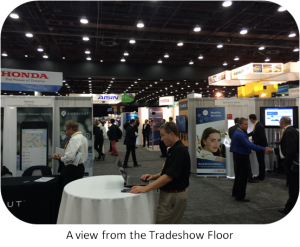
ITSWC Tradeshow Floor

The event brought together a wide range of organizations from giant multi-nationals like Delphi, Nissan and Mercedes to relatively new companies like RideScout, eTrans2020 and zipcar.  In addition there were a number of government agencies, universities, research centers and pavilions for organizations all over the world including Australia, Singapore and Korea.  It was quite the gathering of the ITS talent and expertise.

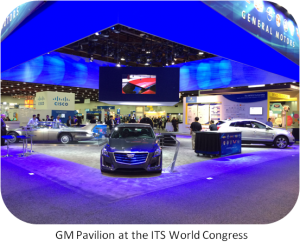
ITSWC GM Pavilion

There were a number of major announcements and happenings at last week’s event.  A sampling of these include:

  • GM’s CEO, Mary Barra, announced that starting with the 2017 model year some Cadillac models will be equipped with GM’s Super Cruise automated driving function and that they would also contain DSRC radios for safety through connected vehicle (V2V) technology.
  • US Secretary of Transportation, Anthony Fox, reiterated the governments commitment to the use of V2V and V2I technologies for safety in future vehicles.
  • Honda provide test rides in their driverless car.
  • Delphi demonstrated their system that determines if the driver is paying attention.

A large part of the discussion the event centered around was how transportation is changing and how the options for people to get from one place to another are really changing.  This was a lesson that I wished I learned better for the show.  I was in Detroit from Sunday through Thursday.  I was staying downtown within walking distance of the convention center.  However, I had two meetings planned in the Detroit suburbs that week.  Being a product of the 1960’s and a life of mostly suburban living, I felt that I needed to rent a car.  This would get me to and from the airport and allow me to get out to the Detroit suburbs for my meetings.  Between the rental car and daily parking, I ended spending almost $350 in transportation.

A better and 21st century plan would have been to use RideScout or a tool like it to find a ride from the airport.  I’ve found this could be from $20 in a shared van to $50 for a ride with Uber.  When I needed to go to the suburbs, I could have rented a Zipcar for about $36.  Given that one of my meetings was cancelled and the other ended up happening in the city, I could have saved over $150.  Lesson learned for next time.

This is an exciting time in the world of transportation.  As could be seen at the ITS World Congress, the rate of change in transportation is accelerating quickly.  It is going to be exciting.


AutonomouStuff

Crash Avoidance Systems

Guy Fraker, AutonomouStuff

Early Autonomous (Active) Safety Technologies: The Early Numbers Are Dramatic

Throughout the past 100+ year history of vehicles and vehicle insurance, the relationship of crash frequency trends to crash severity trends has been remarkably consistent:

Rule #1: Changes in either are measured in single digits

Rule #2: Whenever frequency goes in one direction, severity per event moves in the opposite. i.e. when frequency (number of events) declines, the severity of the remaining crashes goes up.

The numbers in these studies reflect unprecedented disruption given double-digit improvements in both.
Impact Frequencies

The numbers provided in these studies are from Auto Manufacturers with vehicles using one or more sensor based safety system that ALSO have statistically significant consumer use.  These numbers represent insured claims involving coverages invoked by the operator of the owned vehicle with one or more of these systems.  All other coverages have been excluded.

These numbers are significant in terms of general trends and in the comparisons of vehicle to vehicle.  They will have to serve as proxies for larger commercial vehicles and municipal mass transit vehicles, as the deployment of sensor based safety systems is not yet statistically significant.  However, a safe conclusion would be that improvements in frequency should be relatively consistent when applied to these other vehicle use cases.  That said, improvements in severity per event should be magnified the larger the mass of the vehicle in question.  Example:  one of these systems reduces the damage incurred by the vehicle(s) involved in a crash by 23%.   Now assume that same system is applied to a moving bus, or speeding ambulance- the expected reduction in frequency should be greater than 23%.

IMPORTANT NOTE: When crash severities are reduced, this translates into less damage, which will directly result in lower litigation costs, mitigation of driver related worker’s comp losses, long term disability expenses associated with a crash event.  With time, the costs allocated to providing insurance, self, bond, or purchased, will also decline.  Finally, with fewer events, and fewer high severity events, an unmeasured loss from business interruption, negative goodwill (PR) will be yet another benefit.

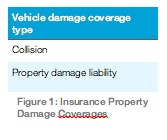
Vehicle Insurance generally provides 4 coverages to repair, or recover, damaged/loss of tangible physical property:

  • Comprehensive- theft, vandalism, broken glass, animals, storm- NOT crash related, not included in these numbers
  • Collision: Crash damage to the vehicle owned by the owner of the insurance policy: Common insured event
  • Property Damage (PD): A liability coverage to repair/recover tangible physical property owned by someone other than the owner of the policy. Common insured event
  • Uninsured/Underinsured Property Damage:  Not an event caused by the owners of these technologies so not included in this study.VehicleDamage2

Vehicle insurance generally provides three of four coverages to protect/indemnify a policy owner against harm to a person :
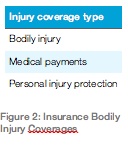
  • Injury Type 3Bodily Injury Liability: Damage caused by the owner of the policy to another person, including cost of legal defense, settlement, and/or jury award up the limit stated in the policy
  • Medical Payments:  Coverage, up to a stated limit, per person, protection for the driver, family members, and/or other occupants.
  • Personal Injury Protection (PIP) This coverage replaces BI & PD liability in those states with a “No-fault”Tort system.  Some Medical Payments coverages and lost wages are also included in PIP coverage
  • Uninsured/Underinsured Motorist: Additional coverage protecting the owner of the policy in the event that are involved in a crash caused by an uninsured driver.  Not part of the studies, as these metrics are all based on the operation of an insured vehicle by the owner of the vehicle.

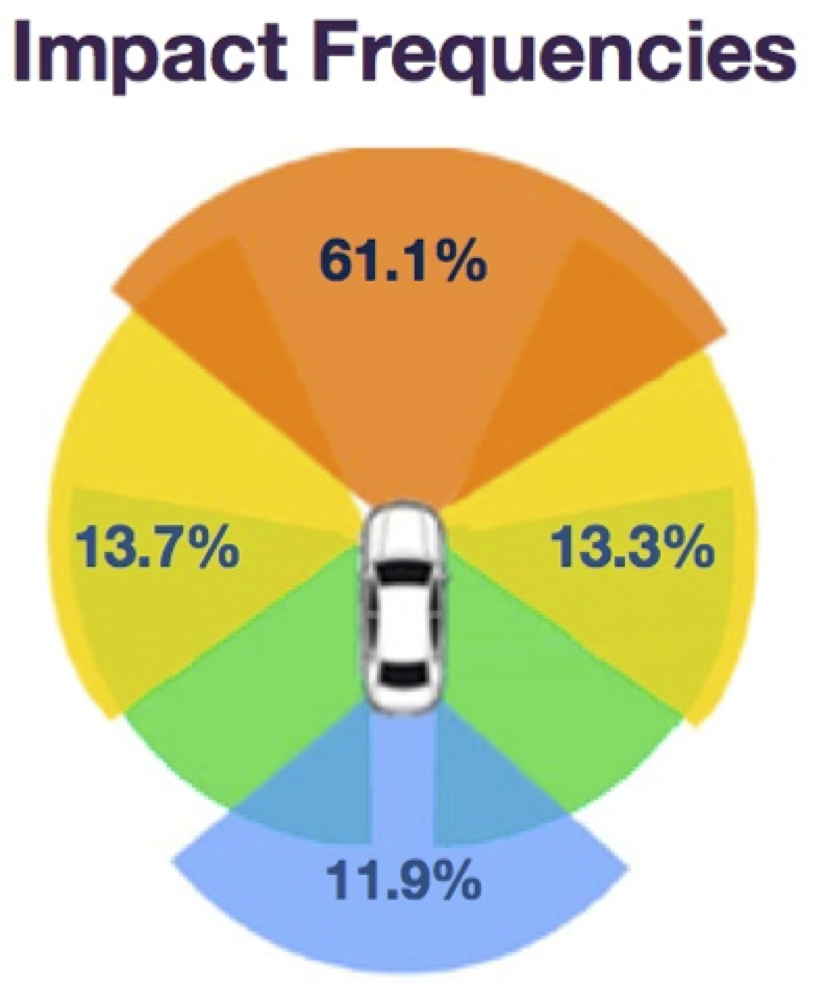
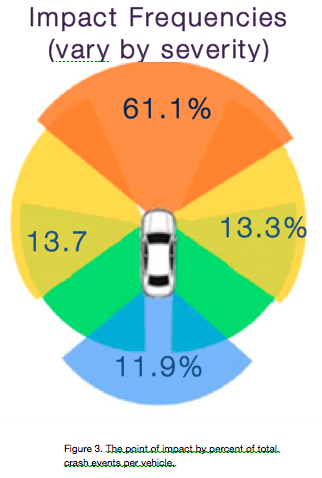
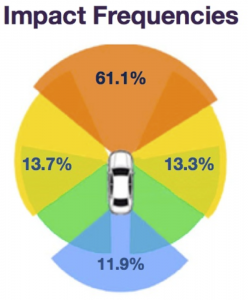
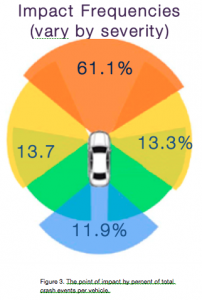
The starting line: How often is a specific location on a vehicle the point of impact in a crash?
Screen Shot 2014-08-14 at 9.49.35 AM

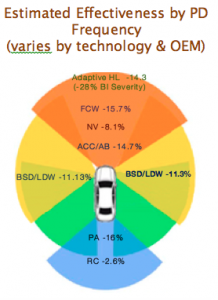
How many more+/-fewer crash events were incurred by vehicles with one or more sensor-based safety system? 
Screen Shot 2014-08-14 at 9.56.08 AM    Screen Shot 2014-08-14 at 8.23.24 AM

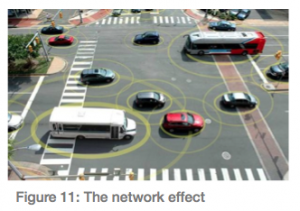
As figure 4 highlights, the impact upon accident frequency rates has thus far been very positive. One aspect that puts these figures into a more dramatic context is that they come from early adoption. What separates these technologies from all prior safety advances, is the compounding impact from what is known as the network effect. By increasing the situational awareness to a 360 degree field of view and simultaneously extending that field of view from an estimated 30 meters to 300 meters, the sensors on one vehicle essentially make the roads safer for the four to five vehicles operating immediately adjacent to the vehicle with the technologies. As more and more vehicles enter the fleet with these technologies, the benefits experience an compounding effect.
Screen Shot 2014-08-14 at 9.05.59 AM

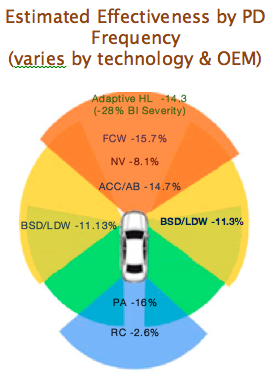
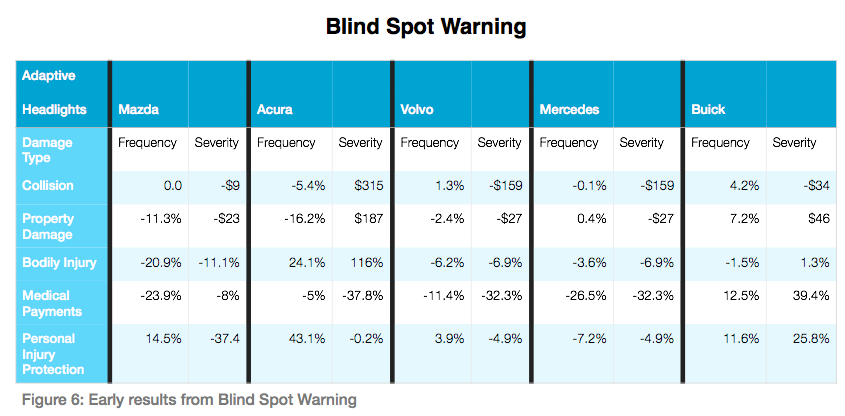
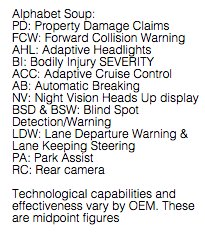
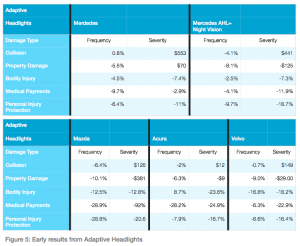
As this first table, Figure 5, indicates, a general category of technologies can yield what can also be generalized as a benefit.  However, as the figures also clearly suggest, much more detailed analysis is needed on both the differences from auto manufacturer to auto manufacturer (OEM) in the technical attributes.  However, equally important is the need for additional human factors research on the differences in the drivers from (OEM to OEM).  i.e. are the owners of a Mercedes materially difference from the owners of a Mazda with respect to these vehicles?
Screen Shot 2014-08-14 at 9.06.15 AM

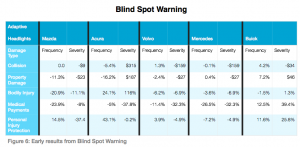
None of the technologies resulted in such a mixed set of results as the blind spot warning category.   An important note is the difference in the technologies by OEM, as some provide a warning, some generate a haptic alert, while others are actual lane keeping technologies.  Again, these results point towards benefits, but significant additional work must be done to determine if the technologies actually cause a driver to be less cautious.
Screen Shot 2014-08-14 at 9.04.59 AM

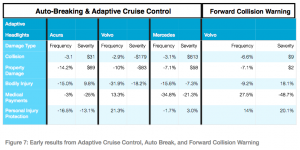
As with the other technologies reviewed, the variance from OEM to OEM is an area for further study.  However, as a category of active safety systems, these are particularly important given the vast majority of crash impact points are on the front of a vehicle.  The volume of double digit
declines from these technologies is particularly noteworthy.
Screen Shot 2014-08-14 at 9.04.48 AM

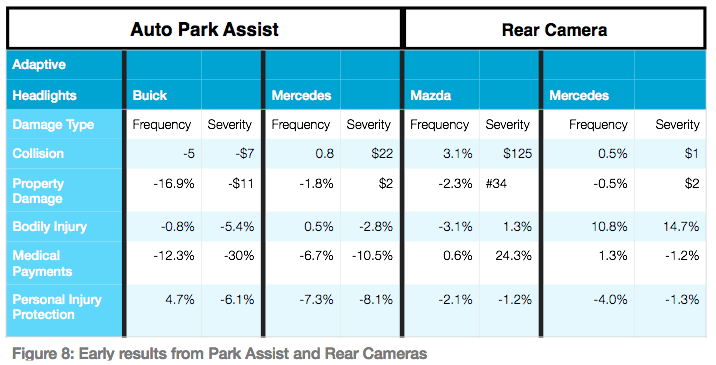
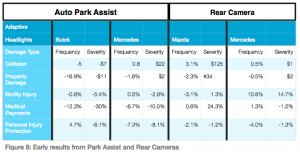
Figure 7 is a summary of early results in two crash prevention systems that are by and large applicable to very low speed incidents.  As such, any dramatic improvements in any of the bodily injury coverages must be taken with a grain of salt, as the frequency of bodily injury claims incurred during a parking maneuver is quite low as a baseline.

In conclusion, the resulting crash frequency and severity improvements, in general is fairly significant compared to both past vehicle technologies and when compared to the historic experience of the insurance industry.  The reason these numbers are so important is how they relate to standard insurance industry forecasts.  This is a classic, living, in real time, case study of an industry relying upon historic assumptions, even in the face of evidence challenging those assumptions.

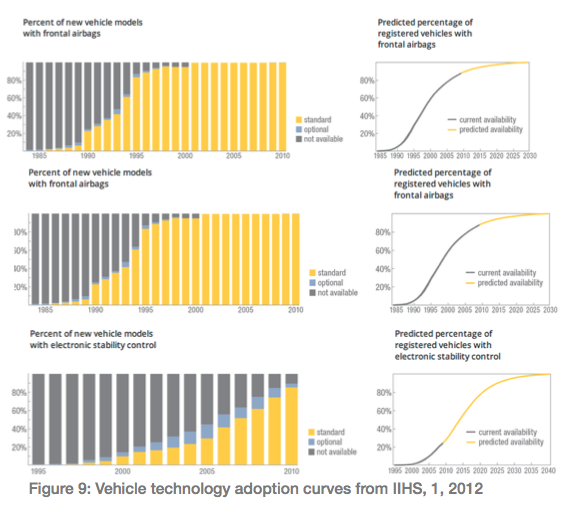
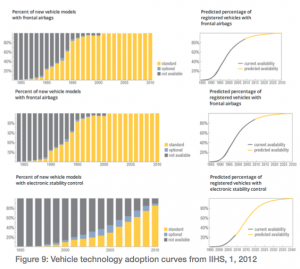
The tables that follow were published in 2012 and 2014 in leading Property & Casualty journals.  The first set of tables appeared in the January 24, 2012 report published by the Insurance Institute for Highway Safety, in an article, “Estimated Time of Arrival”.  The table in Figure 10, appeared in the trade journal Property Casualty 360, circulated in February 2014.
Screen Shot 2014-08-14 at 9.05.12 AM

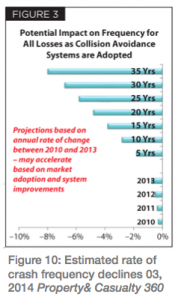
The cause and effect being made in these very well written reports is that the adoption of active, connected, cooperative technologies must be the same as all prior vehicle improvements in order to yield a measurable impact.  However, such a conclusion ignores three fundamental facts relevant to the future more than the past.  First, the pace of declining costs per unit is simply without precedent.  Sensors with a suggested retail price of $20,000 in 201Screen Shot 2014-08-14 at 9.05.25 AM3 will retail for $200 in 2015.  Second, these technologies do create a network effect that by itself will create a dramatic effect.  In very simplistic terms,  as Figure 11 highlights, 1 out of every 5 vehicles can positively impact accident frequency for all 5 if armed with these technological solutions.  This would suggest, as published by the Texas Transportation Research Institute, that a 24% deployment could result in zero accident related stop & go congestion in most major urban environments.  What if a 30% deployment were to were to prevent 60% of all crash events? According to the charts above, such a penetration into the fleet could be achieved within 15 years.
Screen Shot 2014-08-14 at 9.05.37 AM

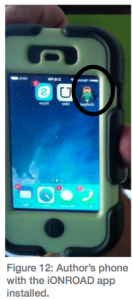
Third and finally, these forecasts ignore the the efforts, and successes, in developing aftermarket active safety systems.  For example, when Harbrick, LLC debuted the Polysync vehicle OS for autonomy, they surprised quite a number in the automotive industry.  Here was a plug & play OS capable of integratinScreen Shot 2014-08-14 at 9.05.45 AMg the data from any configuration of perception technologies connected to any vehicle and the product came from a firm of four located in Moscow Idaho.  At the other end of the complexity and cost spectrum is the forward collision and lane departure warning application: iONROAD, see Figure 12.  For $1.00 any consumer can download a fairly functional app, that includes navigation, telematics data for driver coaching, a dashboard camera, road departure and forward collision warning.  Such a deployment model is not feasible with any of the vehicle technologies listed in IIHS article.
For the first time in the history of motorized mobility, double digit declines in crash frequency and severity are no longer theoretical, but being achieved.  Never has the auto insurance industry faced double digit declines in both frequency and severity over such a brief period of time.  The automated driving experience will be just that- more about the mobility experience.  The impact on the insurance industry will have long since been made.  The time to  engage is now.


Guy Fraker: Founding CEO, get2kno, Inc. & Chief Learning Officer- AutonomouStuff, LLC

Author, inventor, entrepreneur, futurist, and innovation coach- Guy brings a unique perspective both provocative and inspirational. Guy has been on the leading edge of multiple transformations for over a decade. By sharing actual experiences, he brings authenticity to audiences and clients. Guy’s #1 objective is providing practical applications clients use to gain an understanding of scaled disruptions, then how to leverage the leverage or create emergent opportunities. As an entrepreneur Guy is dedicated to enabling access to products and services that empower as an alternative to ownership.

Screen Shot 2014-08-14 at 3.10.49 PM

Guy has been featured in the NY Times, NBC, various Silicon Valley blogs, Thinking Highways magazine, and Forbes. and will appear in an upcoming documentary,“Life onWheels”. He has provided keynotes in the U.S., Canada, India, and Korea, guest lectures at Graduate Schools around the world. He has been engaged by auto manufacturer’s, U.S. and foreign governments, Fortune 100 firms, international trade associations, as well as startup entrepreneurs,Venture Capital firms, and not-for-profits such as The X-Prize Foundation. Guy is also the charter President for the Heartland Chapter of AUVSI, and holds BOD seats at several mobility not-for-profits. Screen Shot 2014-08-14 at 3.07.36 PM

Singularity university
Executive Program, Emerging & Exponential Technologies!
2010 – 2010
University of Georgia - Terry College of Business
MBA, Behavioral Economics!
2001 – 2003
University of Wyoming
BA, History
1979 – 1983 

http://www.linkedin.com/in/gfraker   
What's New

What’s New - September 16, 2014

We’ve added a number of new items to the site including:

We’ve also added a couple of dozen additional news items, so check back regularly.

Driverless Transportation logo

New Driverless Transportation Website

We are very excited to announce the launch of our redesigned website. We have totally revamped the look and feel but more than that we’ve greatly expanded its capabilities.  Some of the features we’d like you to notice are:

  • Redesigned Home Page: The new home page is much more informative than the previous version.  Now right on the front page you can get access to Driverless Transportation industry Articles, News, Events, Publications.  In addition, you can see various organizations in the industry as well.
  • Enhanced Events: You can now see the Events in the industry in a much more comprehensive way.  On the Driverless Transportation home page you can see this months events right on the calendar.  Click on the double arrow and you can move through the months.  If you want a list of events, click on the Events button and see the list.  In addition, each Event now has its own page where we show detailed information on the event including the organizer, location, map of the location
  • Super Search: We’ve gone through and tagged and categorized the over 1,000 items that are part of the Driverless Transportation site.  You can now use the search functions or use the Tag Cloud to find information on a wide range of subjects.
  • Mile Marker: The Mile Marker is our new newsletter that we’re going to start sending every other week.  In the Mile Marker, you’ll find relevant industry information and trends.  If you haven’t already be sure to subscribe.

We have a number of additional enhancements planed for the website in the coming weeks.  Be sure to check back regularly.

DMS Logo

Driving Management Systems (DMS)

One of the many reasons that autonomous cars are a common topic of discussion among the automotive and transportation industry is that it is believed that these vehicles will save lives. Many of the accidents today are caused by driver distraction. Drivers are using their cell phones, iPods, or talking with passengers in the car and these things prevent drivers from providing their full attention to watching the road.

Marwan Hannon, Founder and CEO of Driving Management Systems (DMS) has developed a platform that addresses distracted driving. The NoComm system identifies, isolates and disables mobile devices in the driver seat. The driver is able to use their smart phone with Bluetooth or voice commands but they are unable to use any icons, take photos, or text. The NoComm system will allow an emergency call if needed and provides an “emergency” button that will dial 911 for the driver. Other passengers in the vehicle are able to fully use their devices.

A unique characteristic of this system is that it works independently of the driver. The driver does not have to turn anything on or off and no app is needed for it to work. There are similar technologies out there today but they are not independent of the driver. Unlike the NoComm System, these technologies require the driver to subscribe to the service and download the hardware. It does not prevent the driver from using a passenger’s phone.

The second aspect of DMS platform is a breathalyzer system called the Sober Test. When a person sits down in the driver seat, the Sober system will read the alcohol levels on their breath and will not allow them to drive if their BAC is above .08.

According the Marwan, the DMS platform is ideal for V2V communication. DMS was approached by a police chief in San Francisco who had heard about the NoComm System. He expressed that one of his main concerns is pedestrian safety. He asked if the NoComm system could be used at cross walks at some of the most dangerous intersections in the city. As pedestrians approach the crosswalk and begin to walk across the street, their mobile devices will disable and they are no longer a distraction. V2P and P2V communication would allow alerts to be sent to both the driver and the pedestrian to pay attention and ultimately reduce accidents and save lives. DMS is currently working on this project.

The NoComm System is not on the market yet, but DMS is looking to raise funds to shrink the size of the technology and make it available to the public. Hopefully it will be available within a year but the timeline is unknown.

The NoComm System could be installed at the OEM level in new cars or installed after the car has been purchased. If a parent purchases an older car and wants this technology to protect their teenage drivers, they will be able to take the car to the dealership where it was purchased and have it installed.

The goal at DMS is to save lives and prevent injuries. As a result of texting and distracted driving, thousands of deaths occur each year. DMS would like to diminish those deaths with the NoComm and Sober Systems.

For more information, visit: http://www.dms-inc.net/

eTransArada

Arada Systems and eTrans2020 Announce Partnership

Arada Systems and eTrans2020 Announce Partnership

Fairfax, Virginia. September 2014 – eTrans2020, a developer and supplier of security and testing solutions for the transportation industry, and Arada Systems, a leading supplier of DSRC technology for automotive markets, announced a strategic partnership to bring advanced solutions to enable the connected vehicle industry.

With this partnership, the companies will be able to provide more value to the Connected Vehicle ecosystem. Companies developing applications using Arada Systems technology will be able to more readily test and validate these solutions using the eTrans2020 testing platforms.

“We are really excited about this opportunity. The Arada technology will significantly enhance our product offering and provide substantial benefits to our current and future clients”, said John Estrada, CEO, eTrans2020.

“We have partnered with eTrans2020 to enhance the V2X experience by making it easier for V2X applications to be built and supported on the Arada Systems Platform”, said Praveen Singh, CEO of Arada Systems. “Arada Systems is pleased to partner with eTrans2020 to expand application development and simulation for back testing” added Mr. Singh.

About eTrans2020

eTrans2020 provides cyber security and software testing solutions for the transportation industry. The eTrans2020 TestManager2020™ and V2xTest™ platforms are the foundation for successful, comprehensive automated system and security testing programs.  The eTrans2020 team has significant experience ensuring the delivery of secure, quality solutions.

For more information, please visit www.etrans2020.com or contact us at info@etrans2020com.

About Arada Systems

Arada Systems, originally founded in Silicon Valley as a Qualcomm-Atheros spinoff, now operates worldwide and is a leading developer of DSRC devices along with Wi-Fi devices for the Intelligent Transportation Systems (ITS). Arada Systems provides products for Road Side Equipment, On Board Equipment (including the world’s first mobile-phone based DSRC device). Arada Systems is on the USDOT’s Qualified Purchase List and has deployed its units worldwide, including the US DOT’s Safety Pilot in Ann Arbor, Michigan. Further deployments include full deployments in the ITS World Congress of Detroit in 2014 as well as Belle-Isle, South-East Michigan, Pennsylvania, Washington DC, California and other deployments in Asia and Europe.

For more information, please see www.aradasystems.com or contact us at sales@aradasystems.com

TelematicsUpdate

Telematics Update Connected Fleets: Stats and Forecasts

There are a multitude of facts, stats and forecasts flying around for what the future of fleet management will look like.
Telematics Update recently surveyed a wide range of people in the fleet management industry to see where they believe the industry is heading.

The results can be found here:  telematicsupdate.com/fleet_infograph 


Telematics Update is the reference point for automotive telematics, mobile and web industries and a cornerstone for communications within the industry. We aim to provide you with industry focused news, events, reports, updates and information. Working with you, Telematics Update aims to be the hub of the automotive, mobile & web community enabling dialogue throughout the industry and driving telematics forward. We want you involved - it’s your industry after all - please get in touch if you think we can do even more. Telematics Update is part of FC Business Intelligence Ltd. FC Business Intelligence Ltd is a registered company in England and Wales - Registered number 04388971, 7-9 Fashion Street, London, E1 6PX, UK. To manage your email preferences please visit:  telematicsupdate.com/fleet/unsub.php


IMG_0191

Report From the 2014 Automated Vehicle Summit

The 2014 Automated Vehicle Symposium was held earlier this month in San Francisco near the bay. This was the third event hosted by both TRB and AUVSI and seemed to be a great success.


As we noted in our write-up prior to the event, one of the goals of the symposium’s organizers was to have a diverse audience with a wide range of backgrounds. This goal was clearly achieved as there were a very interesting mix of people from government, academia, the auto industry, and technology. The symposium also did a nice job in having presentations and perspectives from each of these groups. Listening to the various groups, it was pretty clear that they are working on somewhat different timescales.

AVS Show

The presentations from many of those from government related organizations discussed what they have been doing for the past ten years and their new project where they hope to have a demo in about five years. The academics talked about multi-year research and what needs to be better understood in the coming years. The OEMs and Tier 1 suppliers discussed incremental changes that will occur over the next decade or two.

On the other hand, the technology companies seem to have a completely different time scale. Google noted that they started their driverless car project 5 years ago and now have two different models operating and over 700,000 miles on their vehicles. Harbrick which was spun out of Autonomous Stuff just two years ago demonstrated working systems in vehicles.

AVSShow2

As these technology and transportation industries come together in bringing us automated vehicles it will be interesting to see if the technology companies will be able to move the timescales of the historic transportation organizations up or if the industry will bring the technology companies back to their time frame.

The breakout sessions seemed to generate lively conversations and debates. It will be interesting to see the results of these when they are published around the end of September.