This week I attended the Podcar City 7 Conference held at George Mason University’s Arlington, VA campus. The Podcar Group is an eclectic and international collection of Urban Planners, Engineers, and Public Transportation experts who come together to “develop and showcase new and improved modes of transportation based on sustainability and renewable energy.” I attended because the agenda contained a module on Autonomous Vehicles chaired by Dr. Alain Kornhauser of Princeton. I was curious to see how the experts in Personal Rapid Transit (PRT) would view the advances in Driverless Transportation made by Google, universities and automobile manufacturers.
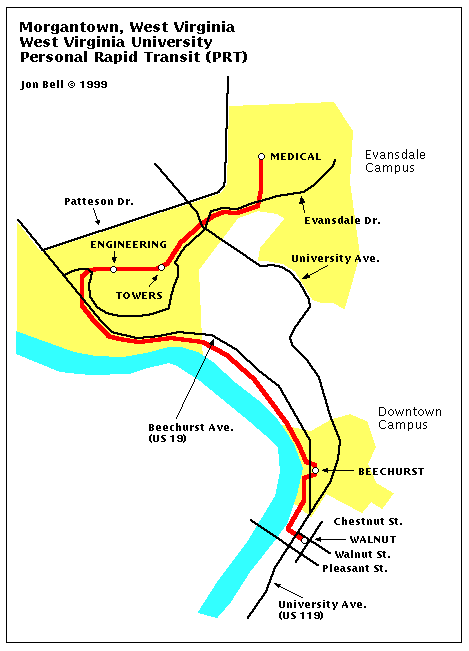
The Podcar concept is embodied in the Morgantown PRT system built in the 1970’s that connects two parts of the West Virginia University Campus. The concept uses smaller cars (seats 8) than traditional light rail or subways, automation instead of drivers, and can be directed from point to point instead of following a fixed circuit. The barrier to widespread adoption is the cost for the required guide-way infrastructure. It is still in the tens of millions of dollars per mile on the average. The Driverless Pods at Heathrow Airport in the UK had an estimated $35M per mile cost to deploy about two years ago.
I think Driverless Transportation technology is going to have an extremely disruptive effect on public transportation in general and systems like Podcars and PRTs in particular. When technology that meets NHTSA’s Level 4 – Full Self Driving criteria is available and affordable, what municipality or government will spend hundreds of millions of dollars on new single-purpose guide-way infrastructure for Podcars or PRTs when they (or commercial companies) can deploy driverless buses or cabs with significantly more flexibility using existing infrastructure at remarkably less cost. I also think that volume cost advantages that millions of NHTSA Level 3 and Level 4 automobiles will bring to the hardware control systems, sensors and software can be deployed to public transportation systems like buses and Podcars enabling them to provide better service for less cost. Unfortunately for Podcars and PRTs, costs for the steel and concrete that are necessary for the required guide-ways are never going to decrease like semi-conductor devices. On the other hand, Driverless Transportation technology, which is based on devices that follow Moore’s Law for cost and size, won’t require large investments in infrastructure and will having ever decreasing unit costs for the actual devices.
Rick